
Exploring Solio Analytics - FPL's Newest Tool
How Can Market Odds Help You Plan Your FPL Team?

FPL has become increasingly competitive over the years. Managers spend hours tweaking their teams, all in pursuit of fantasy success.
Solio Analytics is a new tool which has been created to aid managers with their decision-making and team selection, using advanced (and customisable) prediction models.
I will take an in-depth dive into the tool, aiming to give the reader a greater understanding of the potential power of this model.
What Is Solio Analytics
Solio Analytics is a new website where you can use market odds to best plan your FPL team.
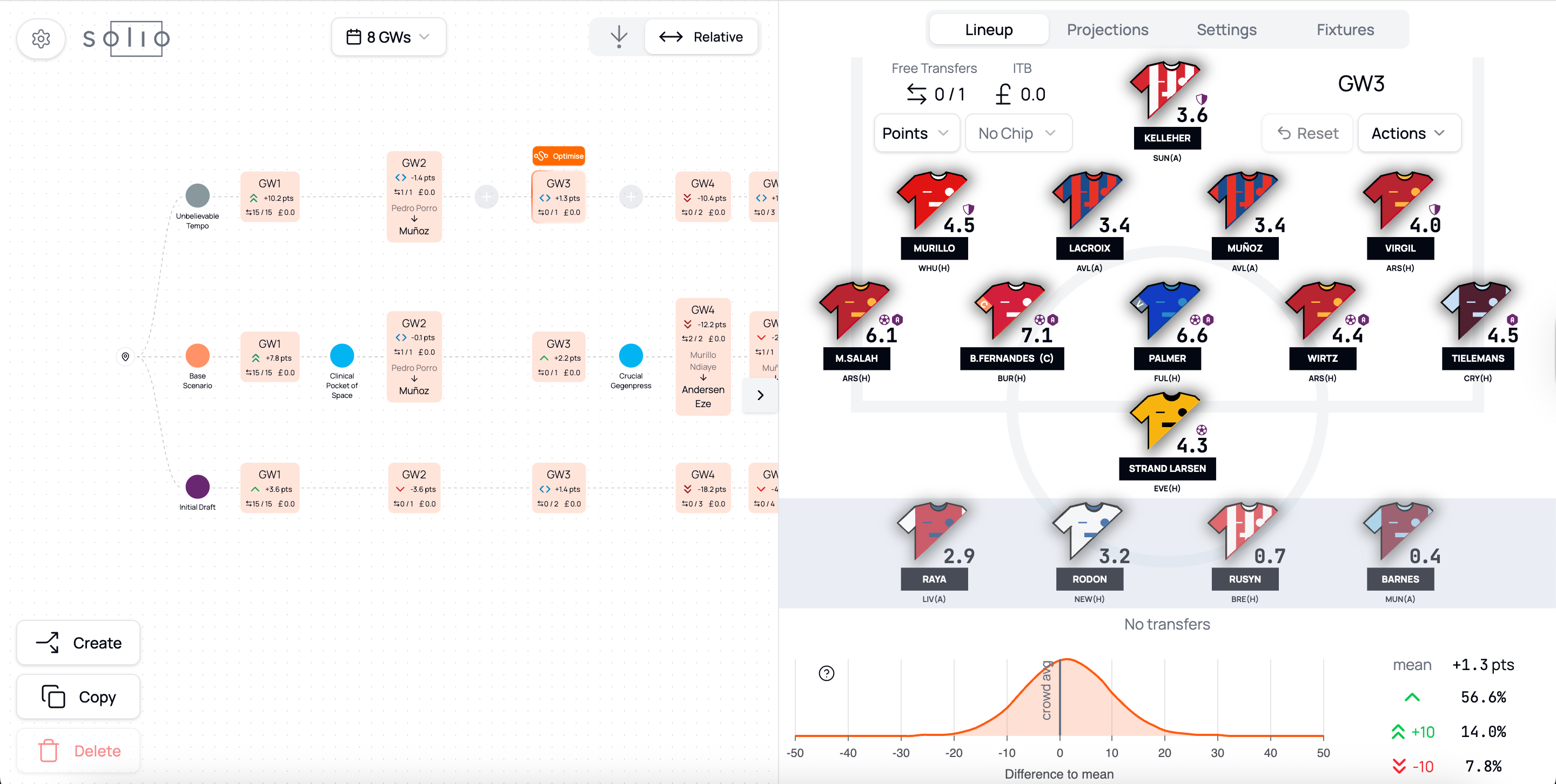
The website contains customisable player projections, full team input and a decision tree used for planning across different events.
The tool officially launched on the 5th August, 2025.
Solio Analytics uses market odds to generate its predictions.
Lead Projection Analyst, RobT, explains in this YouTube video.
Essentially, Solio taps into ‘sharp’ market odds, looking at how many goals are predicted to score, if a clean sheet is likely, etc.
Building Your Team
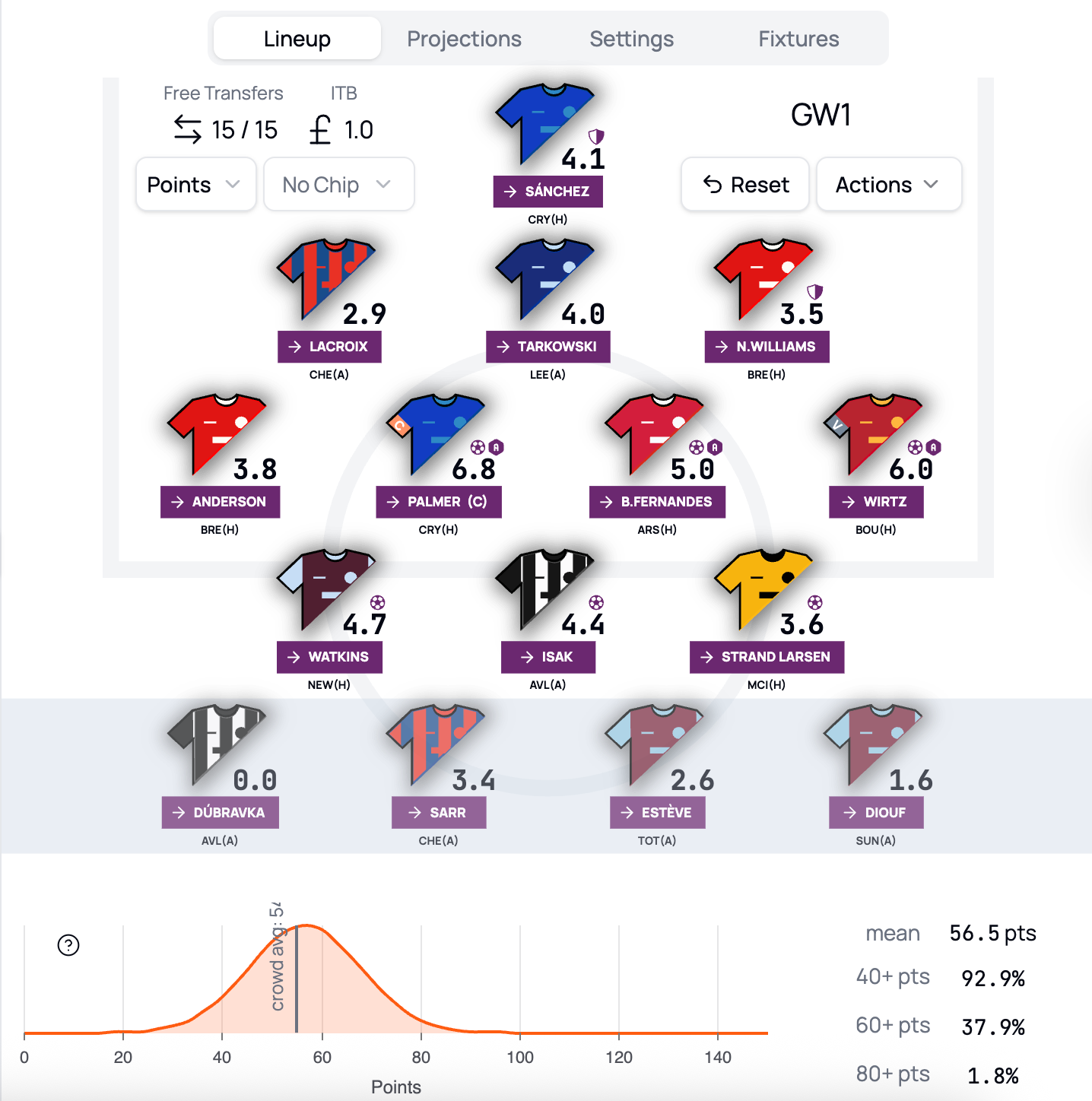
Once you’ve logged into Solio Analytics, you will be able to create a team. Above, I have selected my current GW1 draft.
Next to the player’s name, you can see their predicted points scored for this game week.
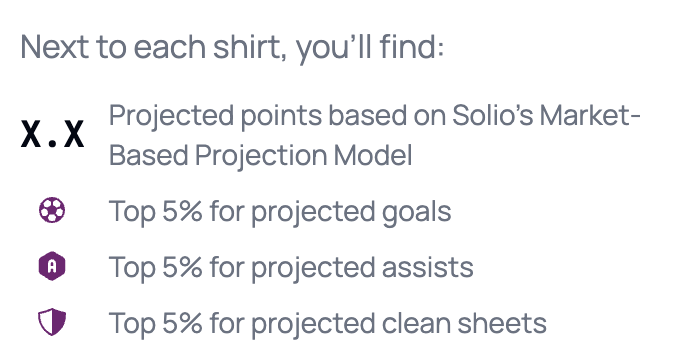
Solio have also included some icons. You may notice that in my draft, Bruno, Palmer and Wirtz are in the top 5% projected players to return goals and assists. Neco Williams has a clean sheet icon, too.
Along the bottom, you can see some of the model’s predictions regarding team points and its variance. Solio expects my team to score 56.5 points.
The variance is underneath the orange curve. The model believes some players’ scoring ability is volatile, widening the range of possible outcomes.
For example, Salah could plausibly return 3 points or 16 in his opening fixture against Bournemouth. The curve would widen to represent this variance.
Effective Ownership is taken into account too. Owning Salah is not considered a risk due to his high ownership, so if he ends up blanking, the model is aware that the majority of managers will own the Egyptian.
It also provides the chance of my team returning above certain point thresholds.
However, FPL is not an absolute game - it’s relative.
56.5 points could be the highest or lowest score in the world. Ultimately, a good point-scoring week is relative to other managers.
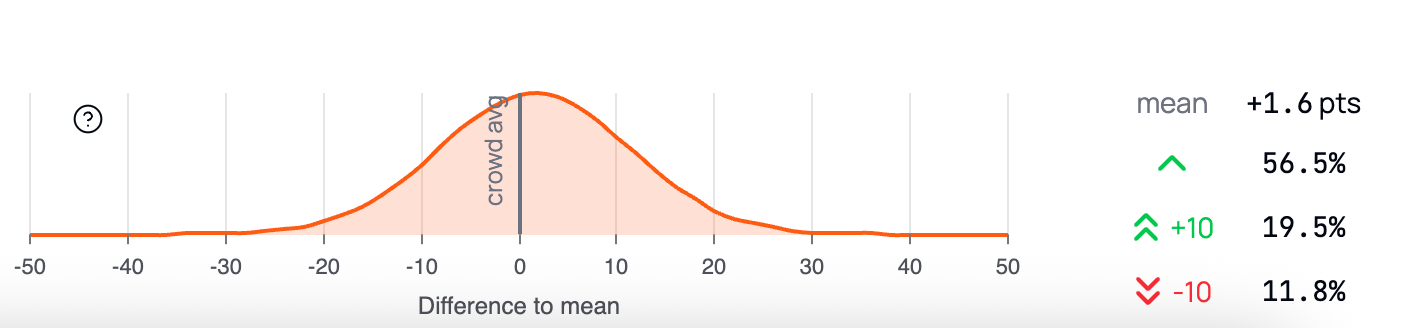
Solio Analytics allows the user to change the model to ‘Relative’ mode. This compares your point scoring to other managers’ (predicted) scoring. This is calculated using predicted ownership / EO.
The relative model is shown below.
Looking at the prediction, you will notice Maxence Lacroix is only predicted to return 2.9 points in GW1.
I can click on him to initiate a transfer.
Replacement options pop up, detailing their key information as well as their GW predicted points, the sum of the difference in points as well as a week-by-week comparison.
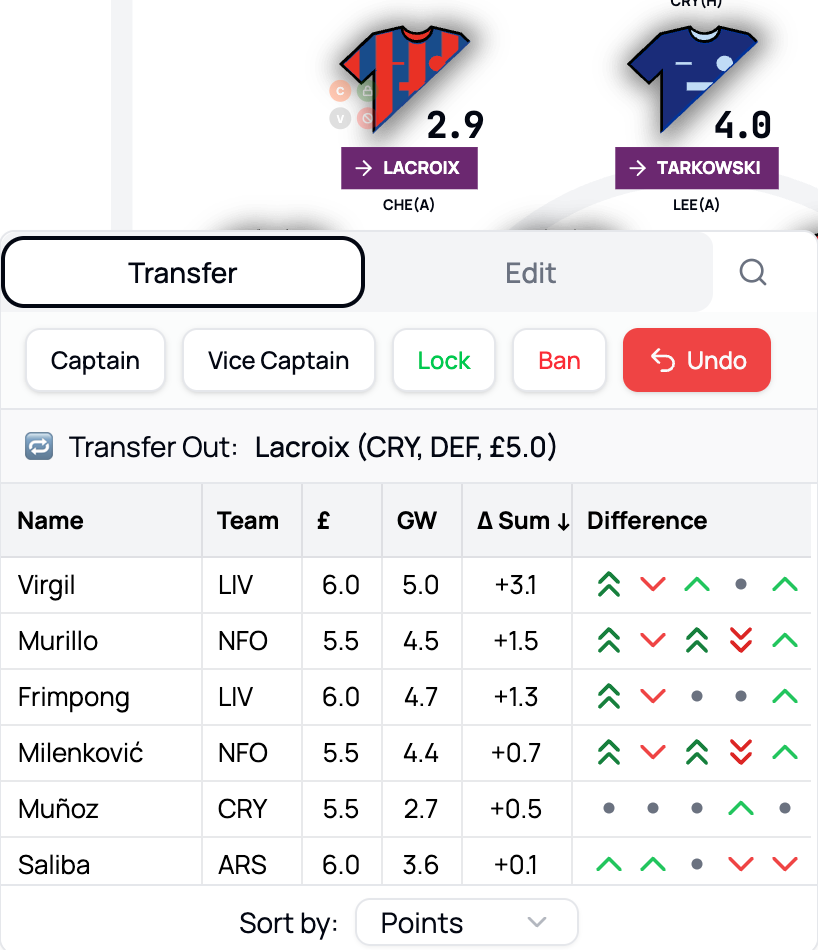
In this case, Virgil would be my best replacement as he is predicted to score more points than Lacroix in three out of five weeks.
If you did this and didn’t have the budget, the suggested player is highlighted in orange.
The Decision Tree
A huge feature and selling point of Solio is it’s decision tree.
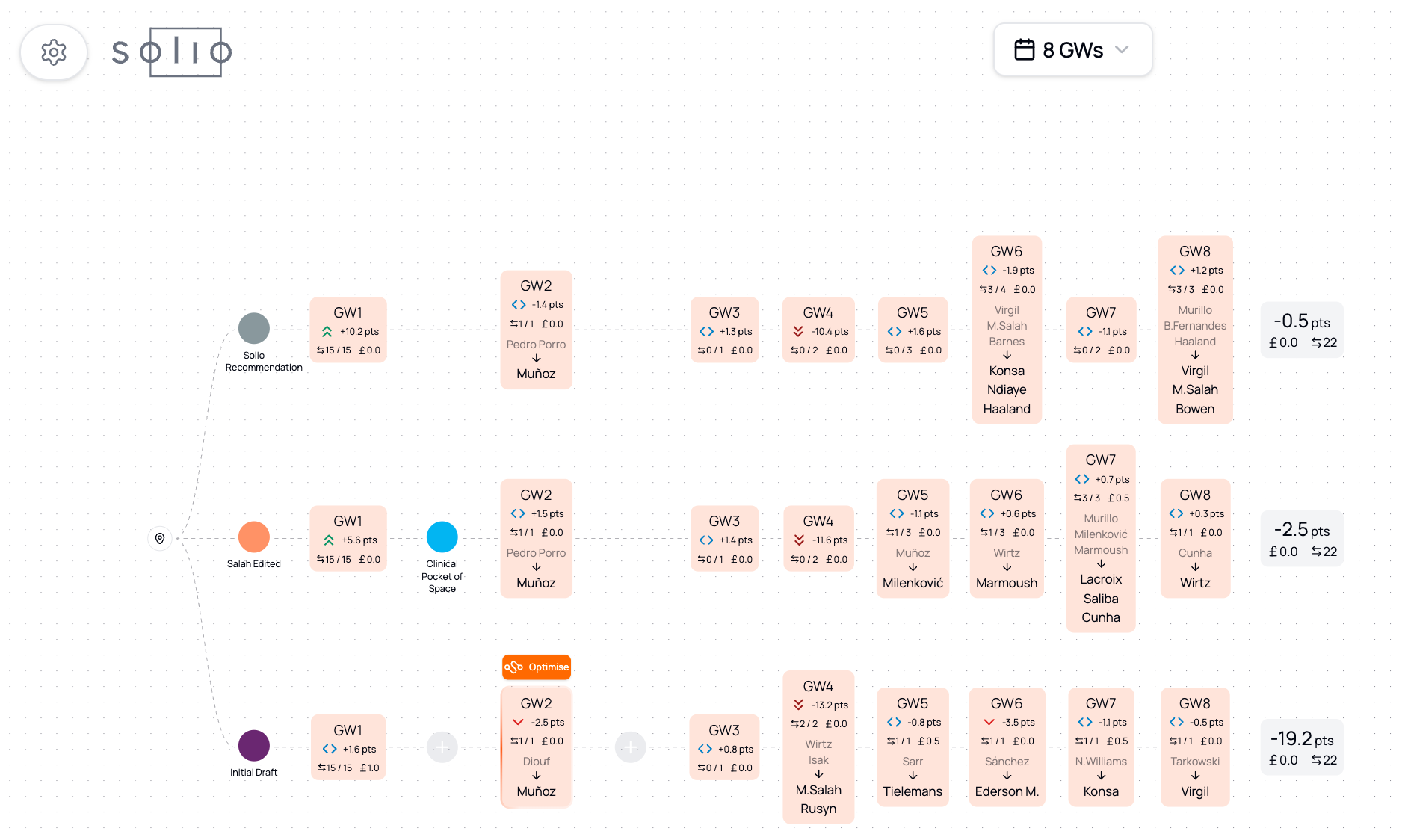
This is where managers can plan, and most importantly, prepare for uncertainty.
Football and FPL is FULL of uncertainty and unknowns. Players get injured. They hit bad form. Teams underperform. This is where Solio’s decision tree shines.
I have set the optimisation for the first 8 game weeks. 12 is the current furthers the model will go, but of course, everything can change between now and then.
In this example, imagine I am targeting a GW9 wildcard so I have optimised until then.
The bottom tree shows the draft I showed earlier. I asked the model to optimise the team from GW2 onwards.

It makes suggested transfers which you can see in the boxes, starting with Diouf to Munoz in GW2 (this is within budget of course).
The predicted relative performance is shown at the top of each box, and you can see that my predicted team, even with optimisation, is average at best.
The model predicts high chip usage in GW4, which is why all three drafts are well below the average.
Customisable Player Projections
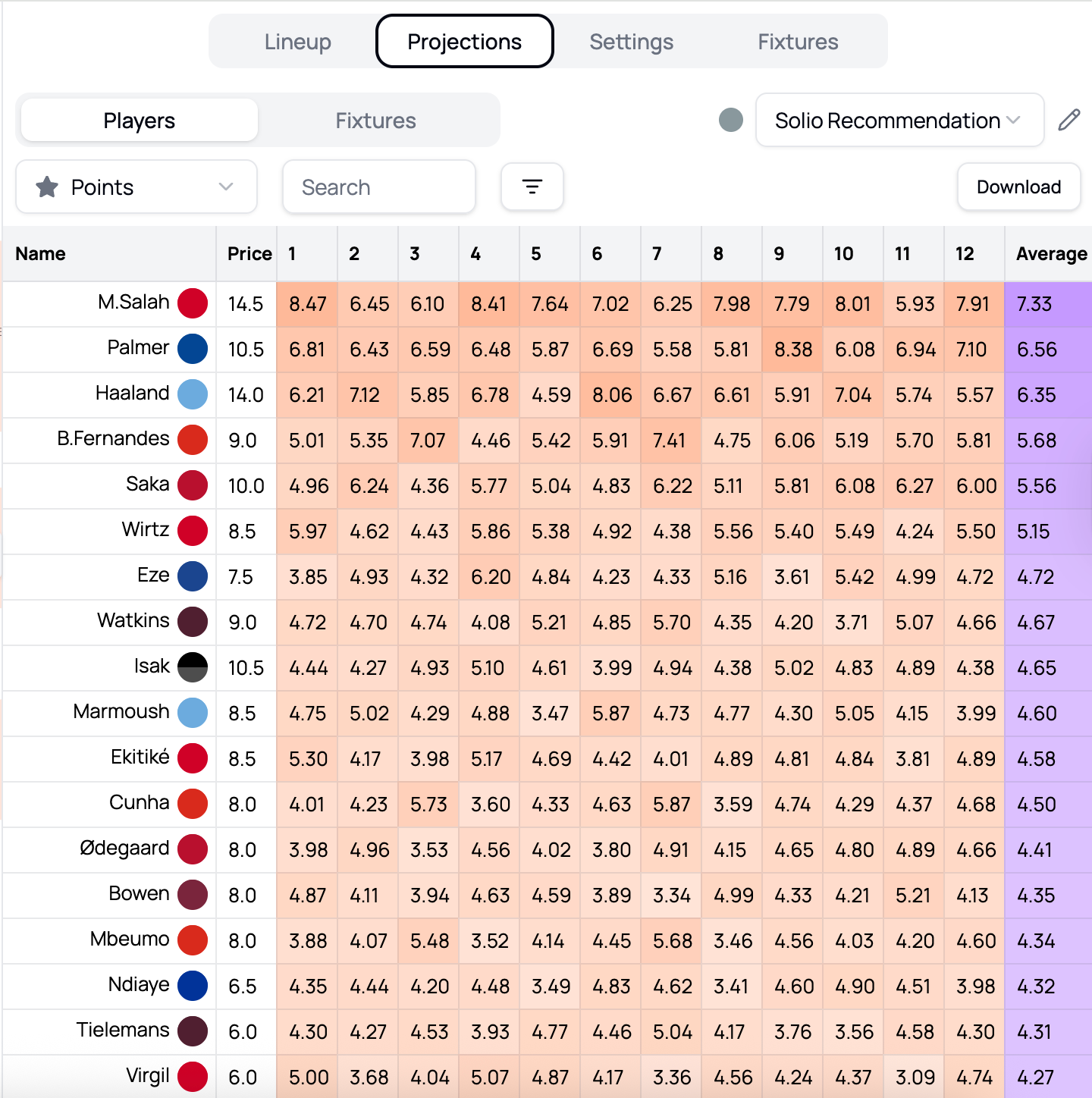
Projections can primarily be used to predict a player’s points scored across each game week. Here, Salah tops the charts, averaging 7.33 points per GW across the first 12 fixtures.
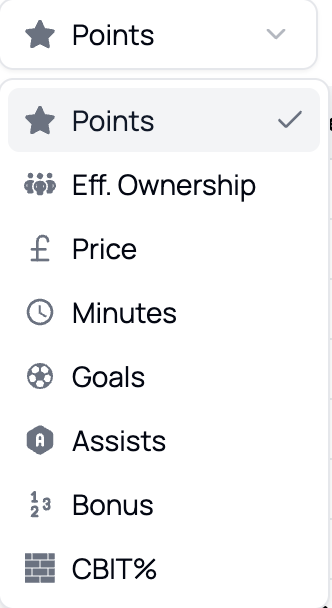
You can change the projections to display different metrics too, as well as filter the view to narrow search results.
What’s amazing about Solio is our ability to alter the projections.
Here are Mo Salah’s projected goals and assists per 90 across each gameweek.
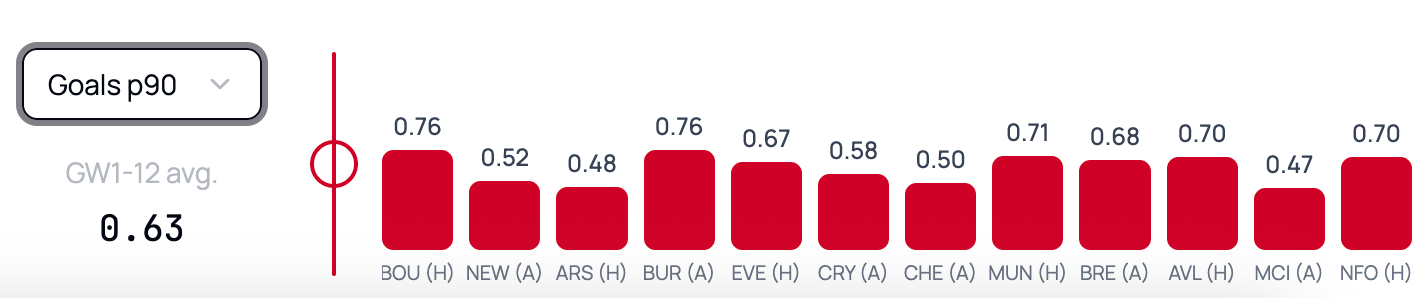
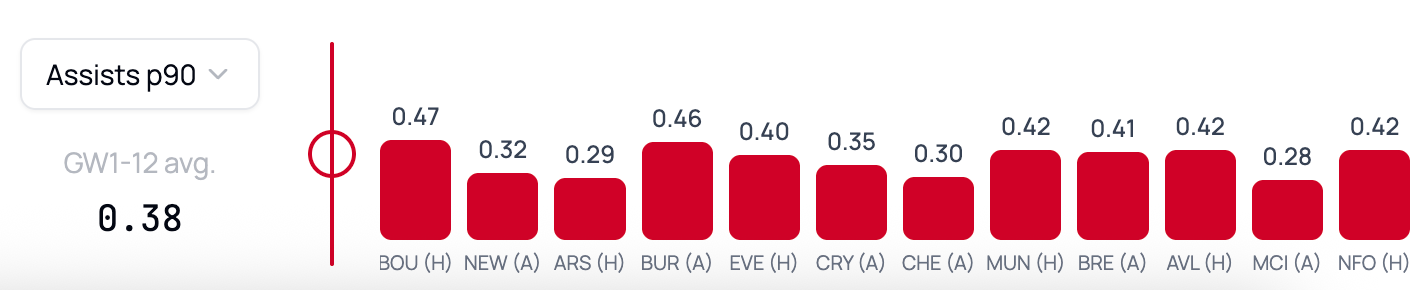
On the left, is his average across the 12-game run. On the right is his projections for each match.
Users can change his average score, as well as his game week values.
I do so below, lowering both G/90 and A/90.
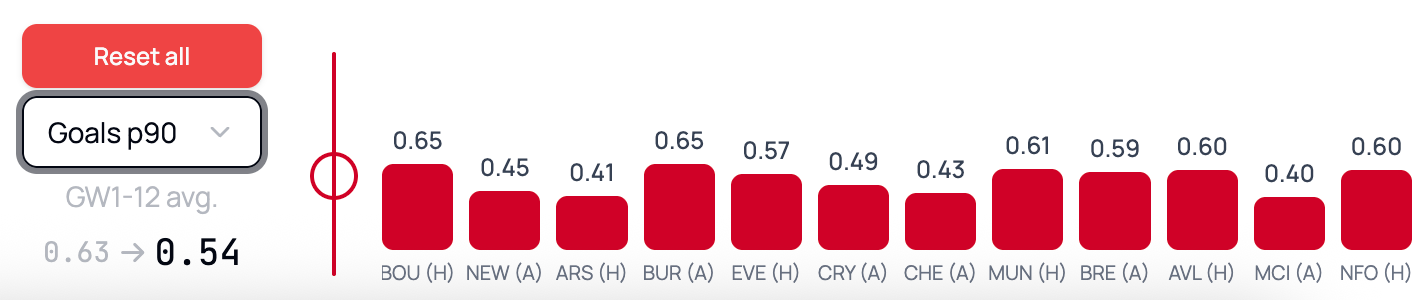
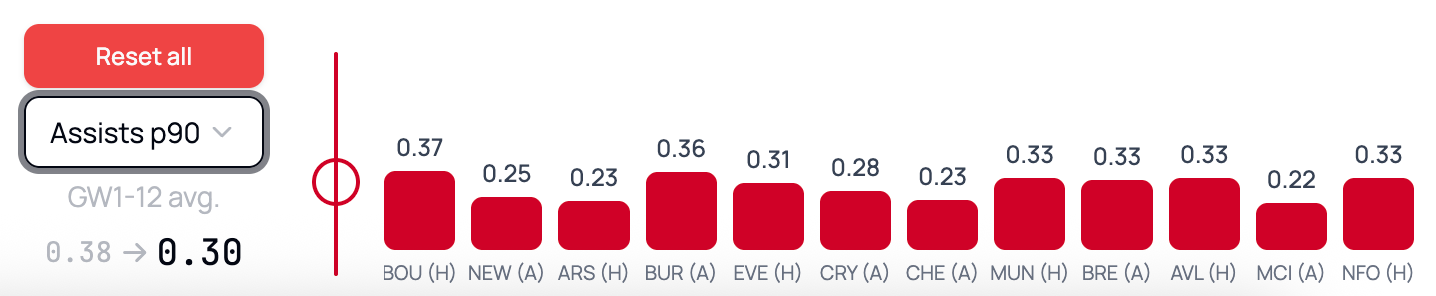
Lowering these projecting effects Salah’s overall projection, lowering his average points per match.
Later on, I will explore three decision trees using the customisable projections.

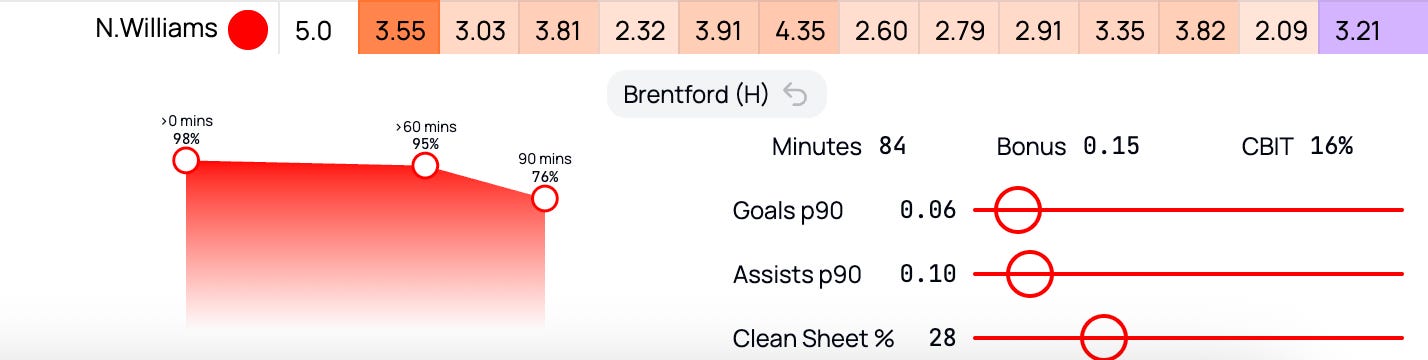
For defenders and midfielders, the projection of course takes into account the likelihood of a clean sheet and the chance at reaching the DEFCON threshold.
Below we see Neco Williams’ odds for his GW1 fixture against Brentford.
Stochastic Planning
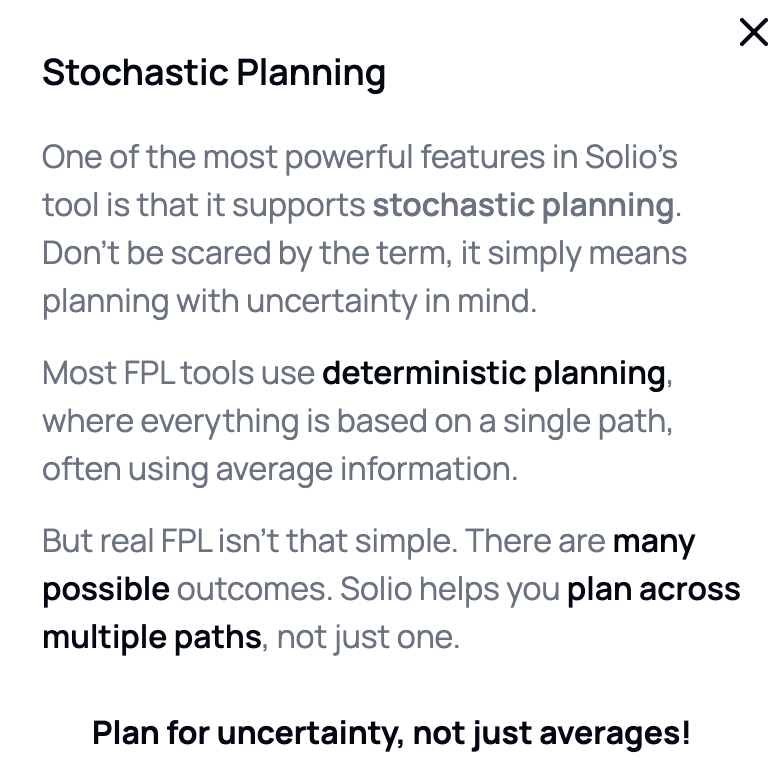
This is where the tool outshines other current FPL planning sites. Managers have the ability to create different planning trees.
Solio’s Optimal Team
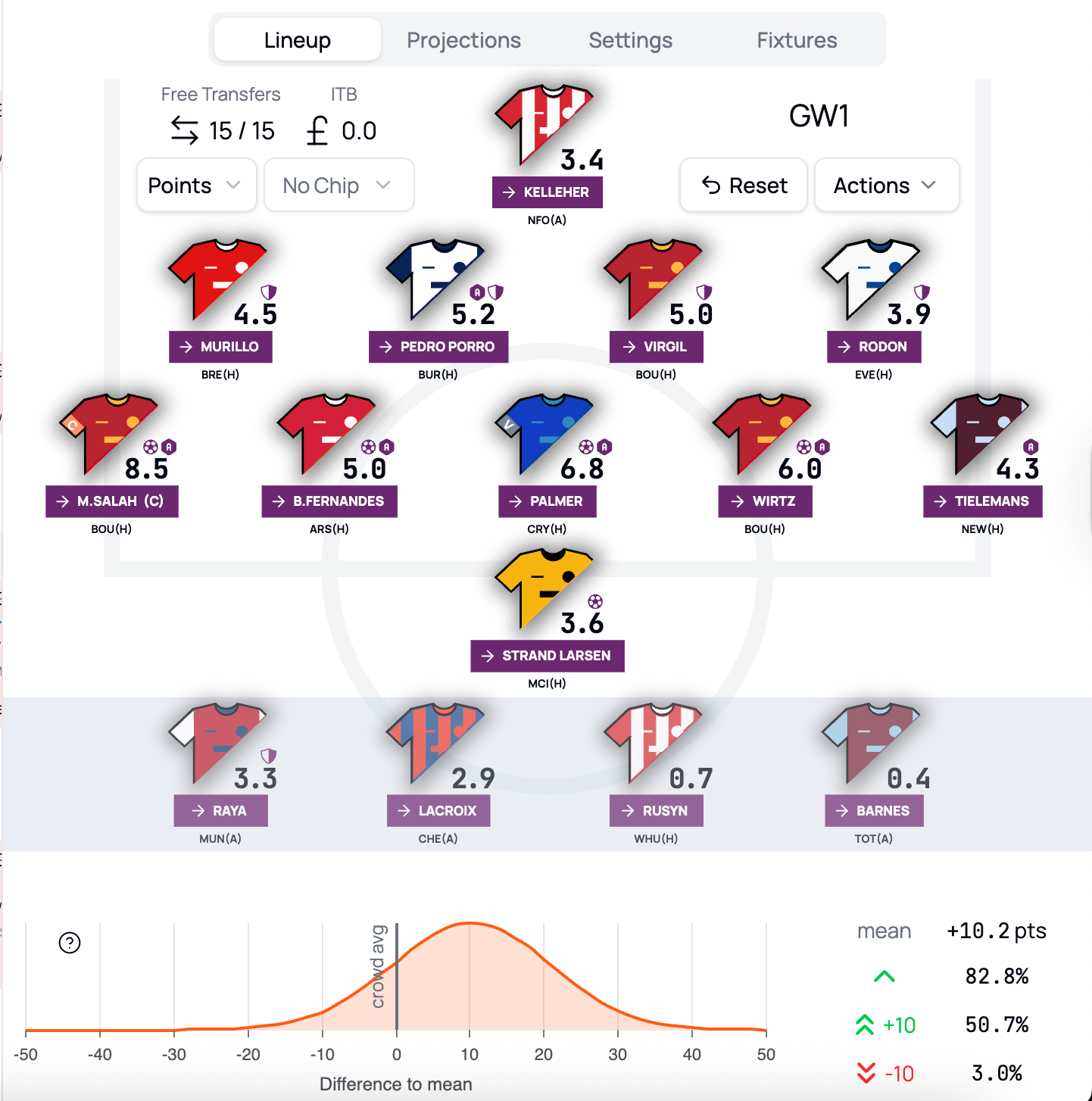
According to their projections, this is the best team to go into game week 1.
This lineup, and subsequent transfers, score the most points across the first 8 game weeks.
The recommended transfers are seen below, alongside the relative performance of the team with no chip usage.
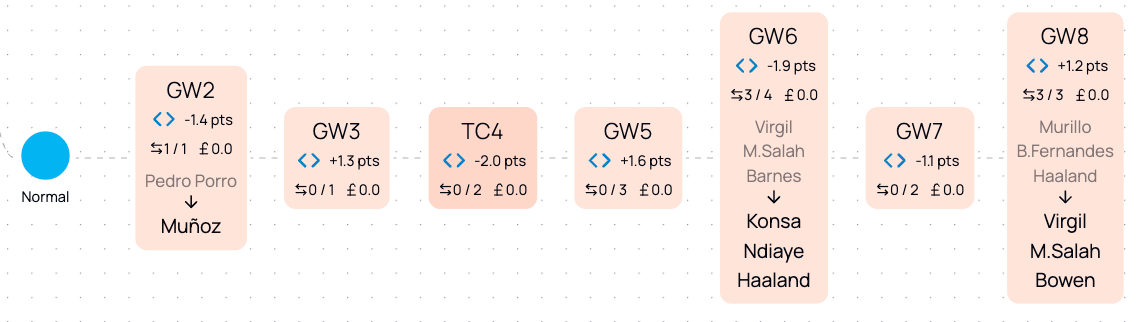
Salah stays in the side until GW6, where the model prefers Haaland for the final three game weeks.
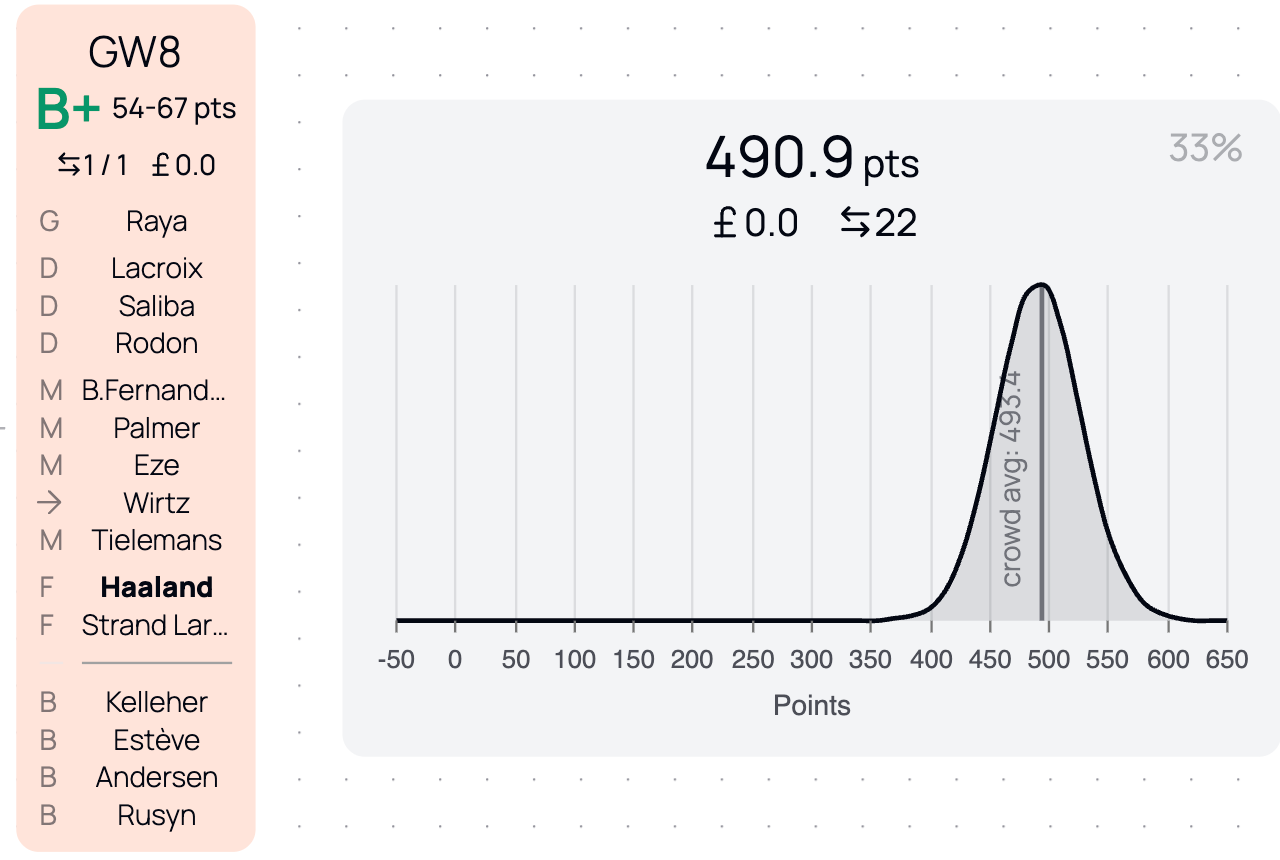
The final GW8 team is shown below, alongside the absolute points performance.
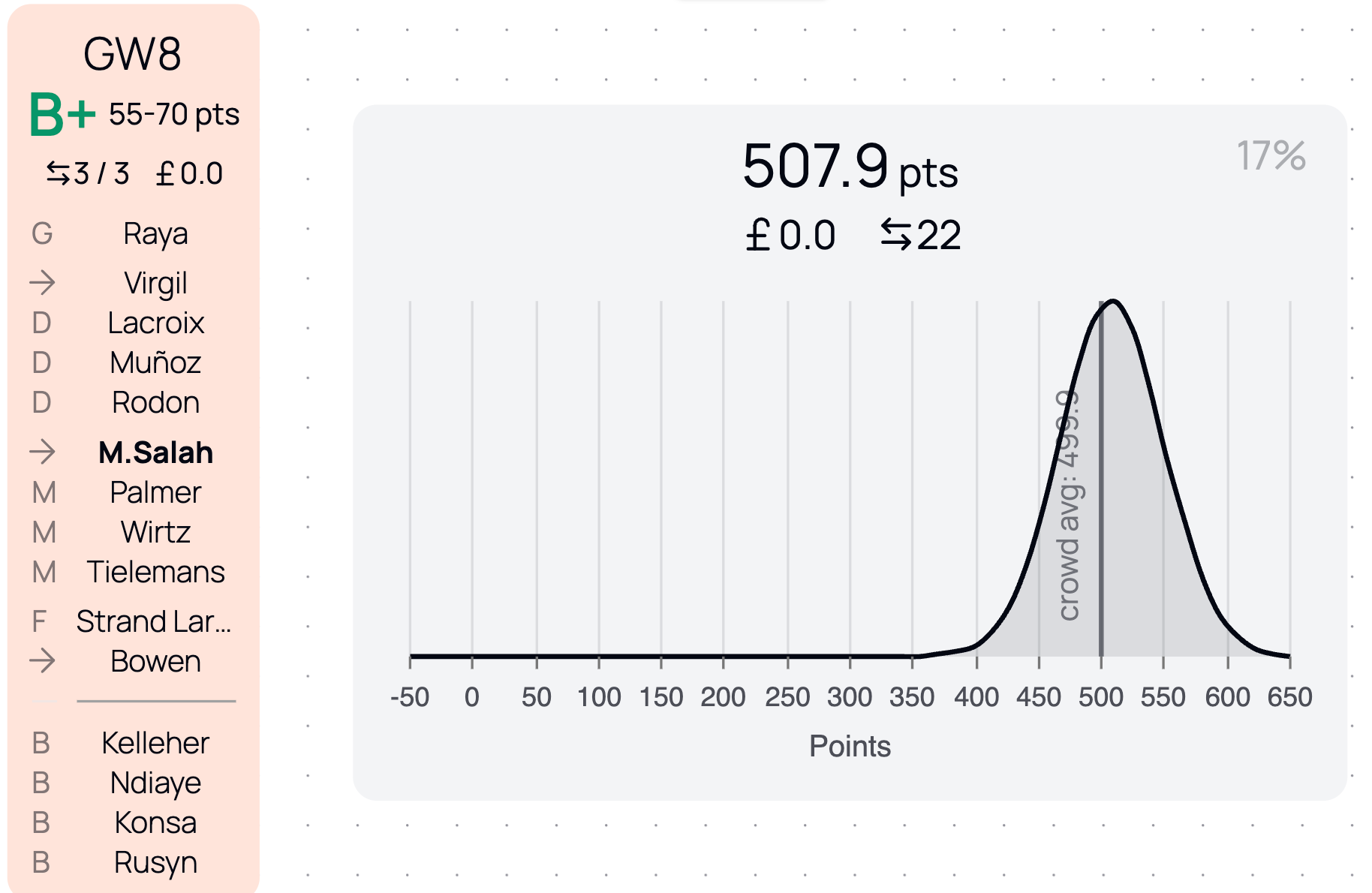
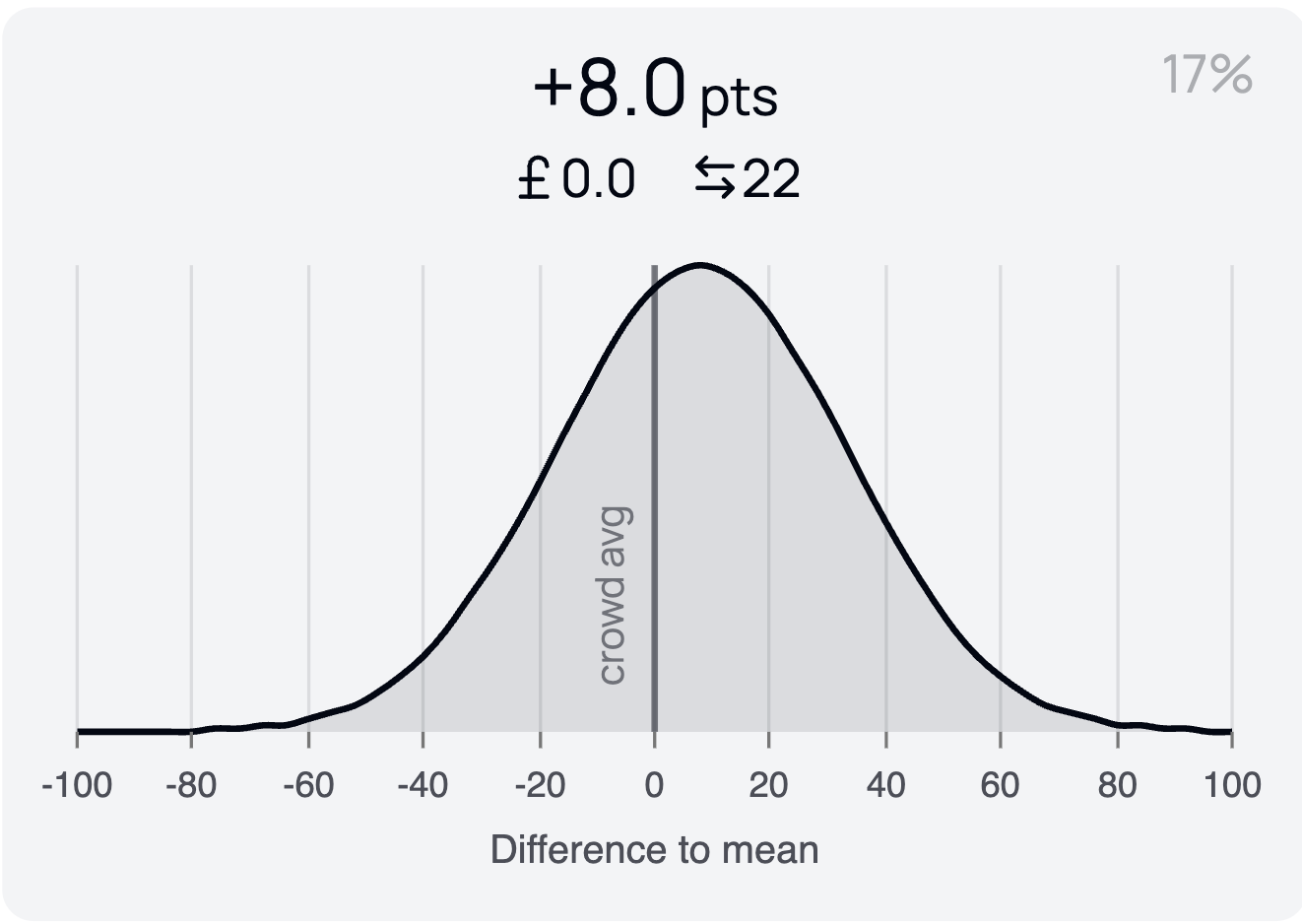
In relative terms, this team beats the mean by 8 points, without any chip usage.
You can also see the variance, with it being possible for this pathway to end you 60 points behind the average, and even 80 points ahead.
I will now use the customisation tools to showcase some ‘What If’ scenarios.
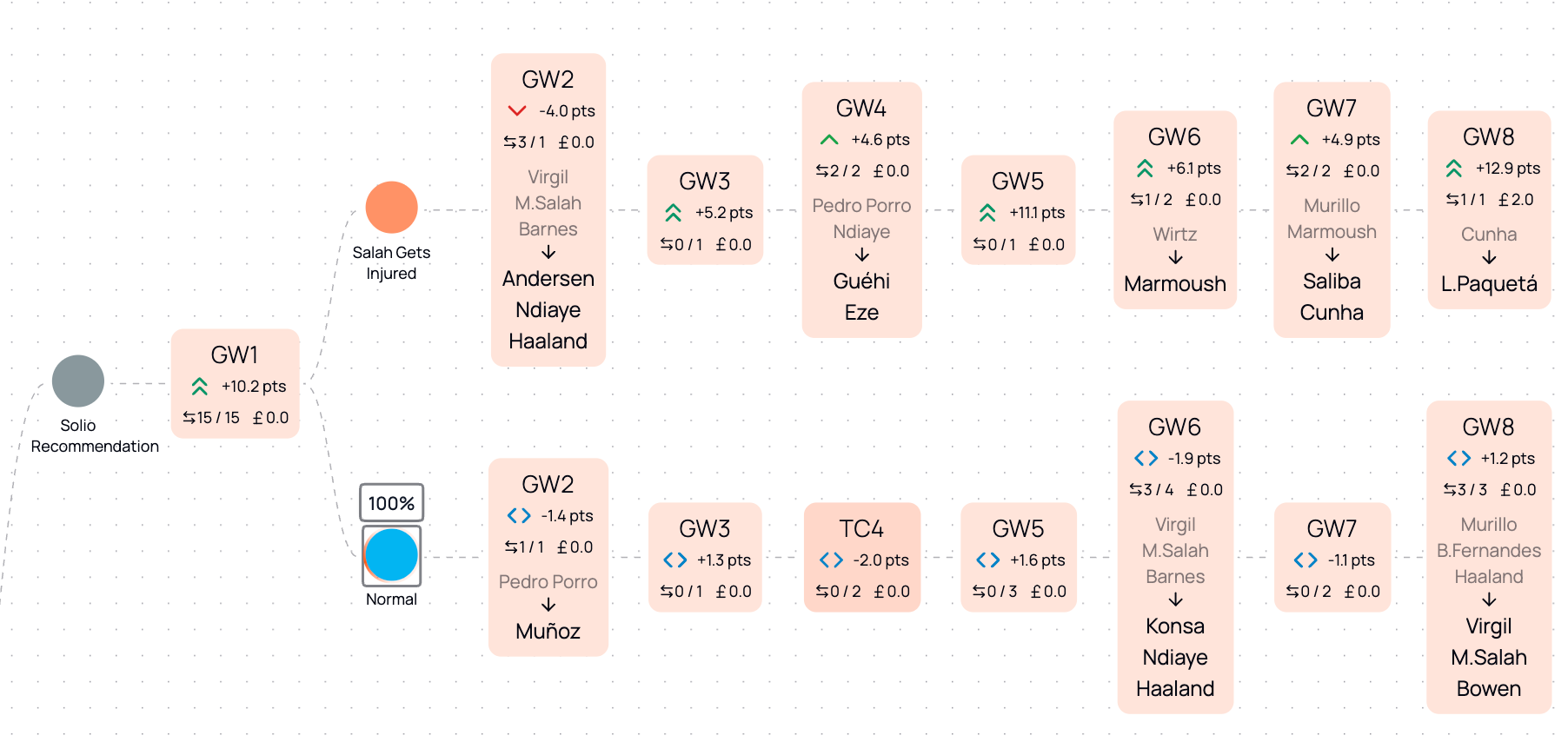
What If: Salah Gets Injured
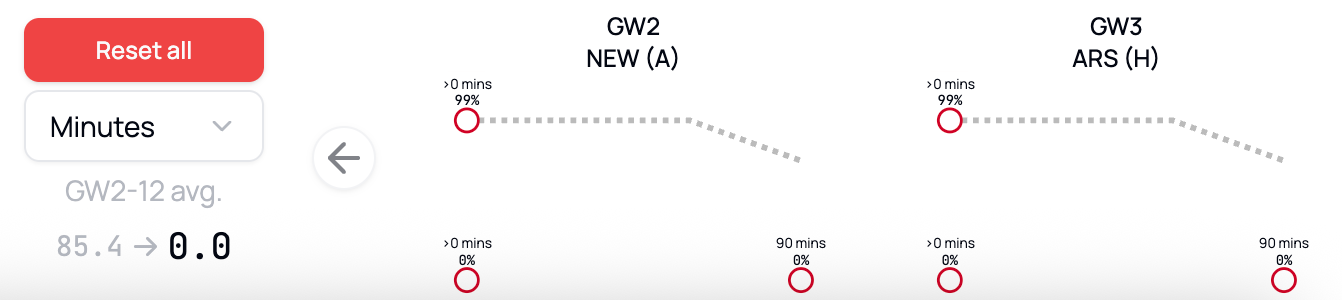
Below, I create a scenario where Salah gets injured in GW1, and doesn’t feature again until after GW8.
To do this, I can change his minutes projections to 0. This removes all possibility of him scoring points, for my own and everyone else’s team.
Another great feature is the ability to ban/lock players.
In this example, I ban Salah from being in my team (despite the model knowing he will receive 0 minutes and not select him anyway).
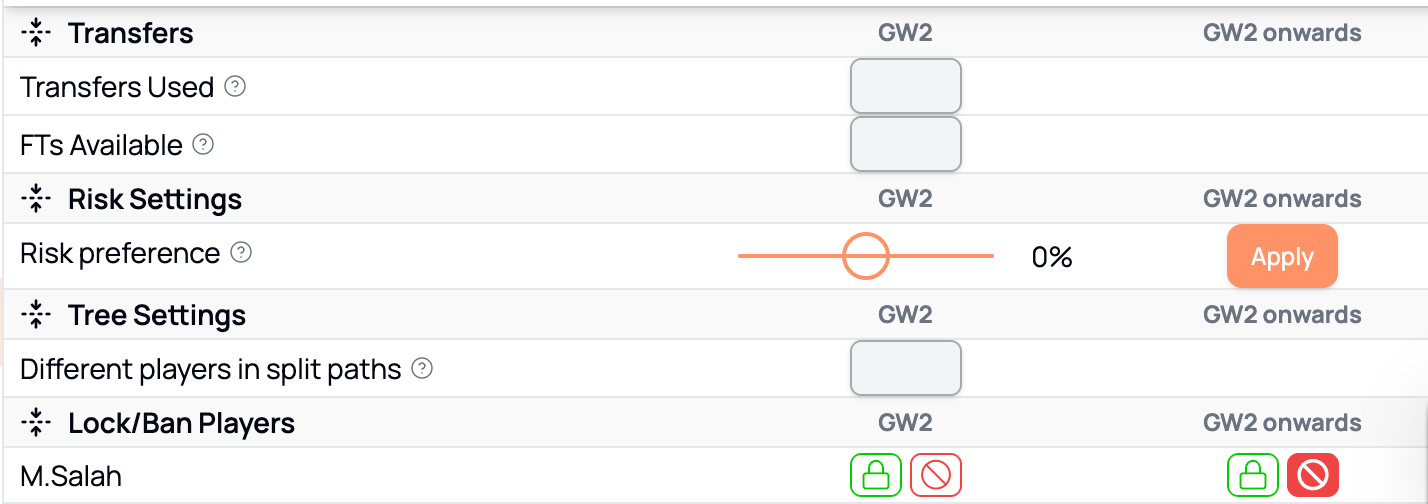
One word to describe me this season is Salah-sceptic, so I expect to be banning him from a few of my team pathways this pre-season.
On the other hand, you could lock a player into your projections if you have a great gut feeling about their upcoming season.
As you can see below, Solio wants me to instantly take some transfer hits in order to transfer in Haaland (indirectly) for the now-injured Salah.
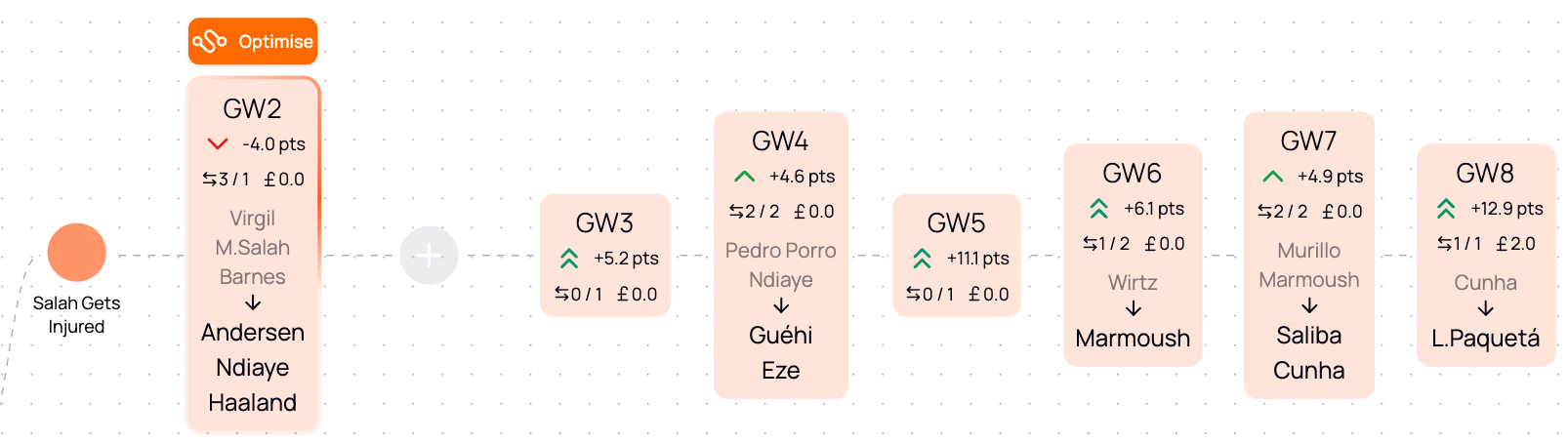
The GW4 projection becomes a lot more positive, as the option to triple captain Salah versus Burnley disappears.
What If: Salah Starts Badly
Using the adjusted projections from earlier, I re-run Solio’s optimisation model.
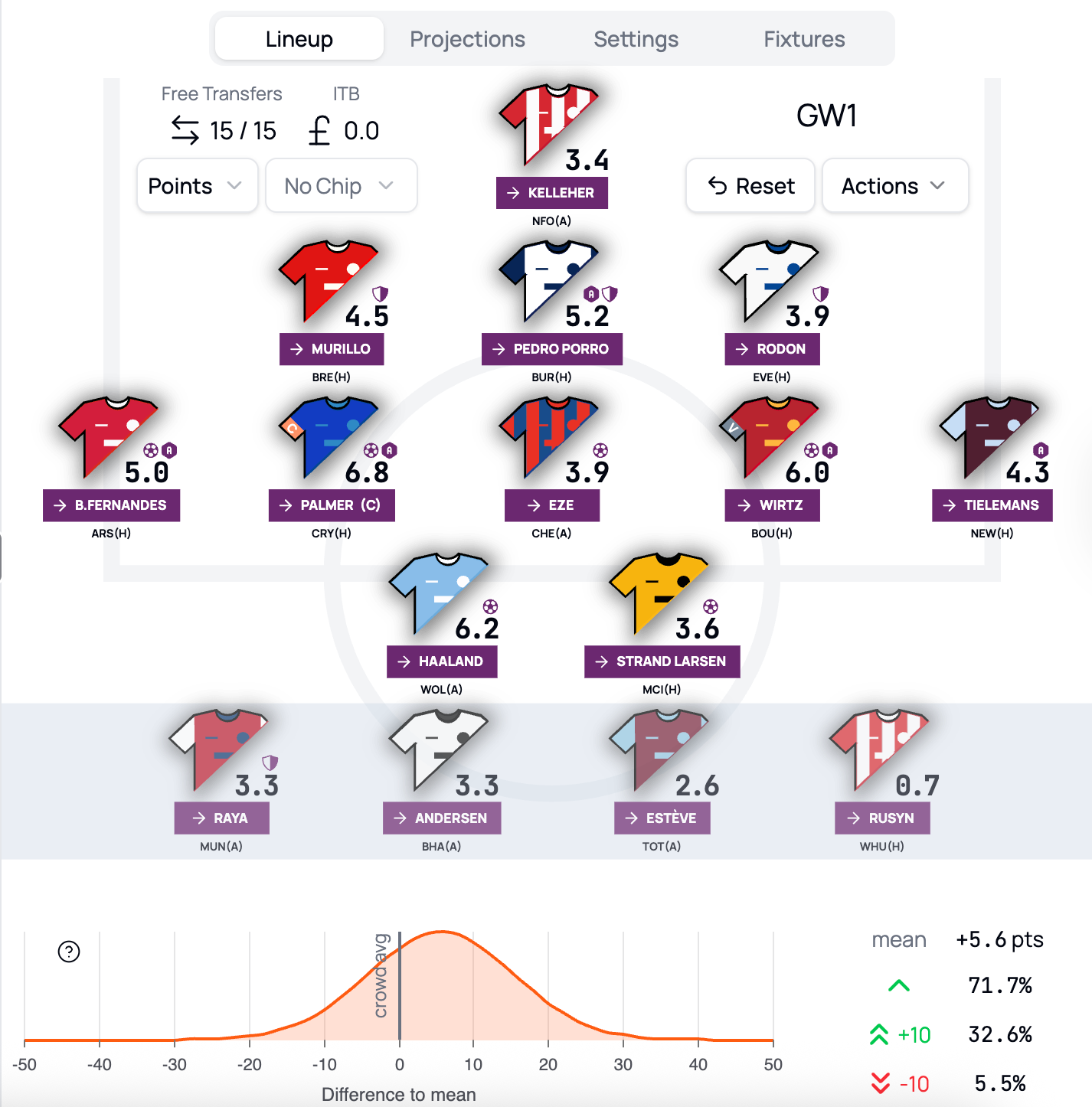
In this case, Solio doesn’t recommend starting with Salah, and goes with Haaland instead.
The projected optimal transfer path is shown above, with Munoz coming in and out before Forest defenders Murillo and Milenkovic being dumped in GW7.
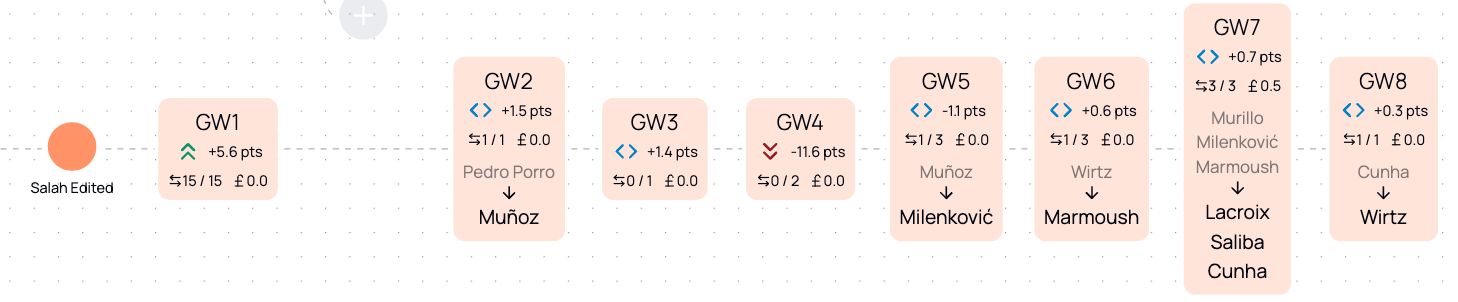
The end team and points look different, scoring around 17 points less than a scenario where the projections are spot-on regarding Salah.
The Entire Picture
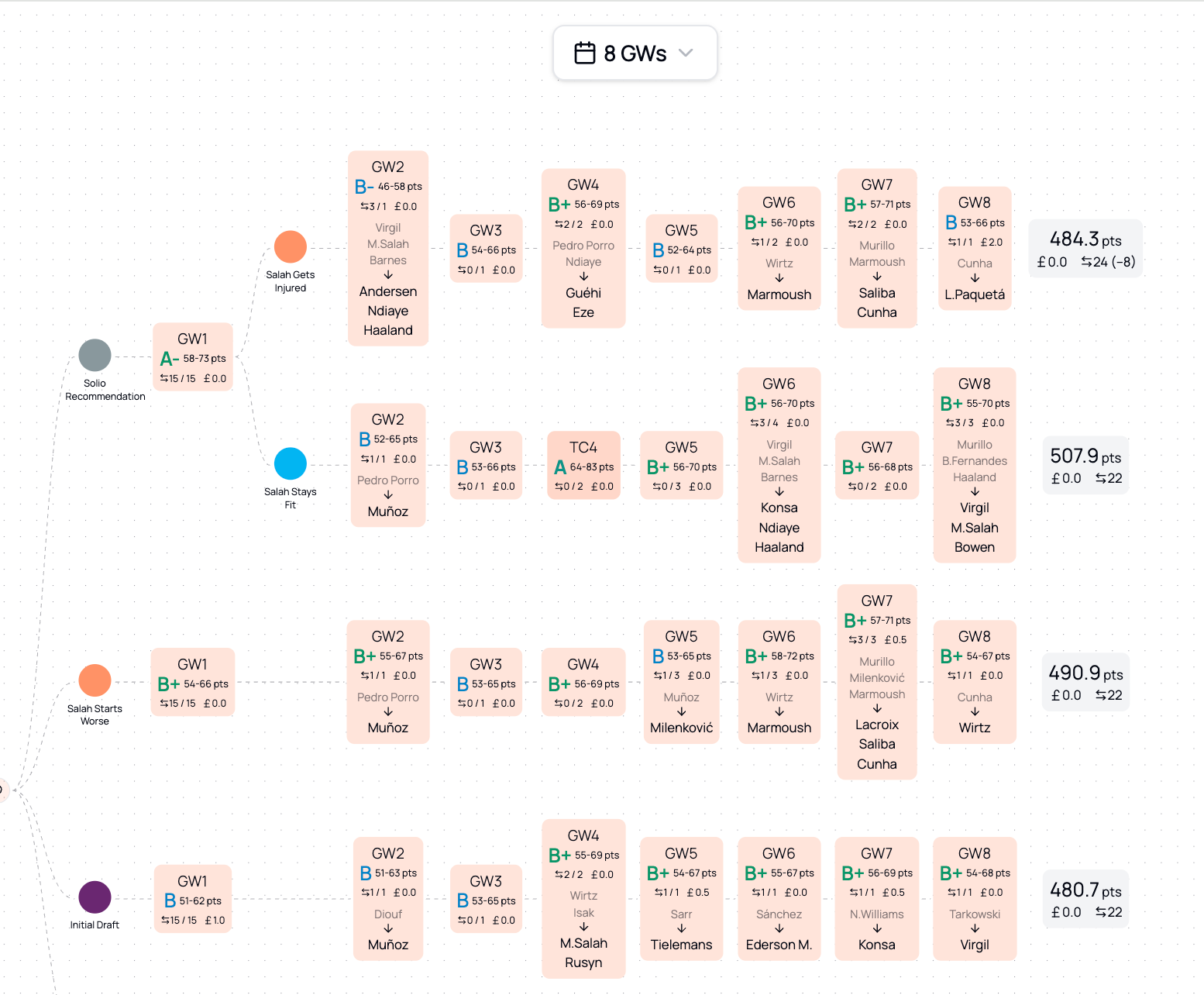
Here is the entire path view of each possibility I have mentioned.
I have since realised that when I edited Salah’s projections, I initially decreased his clean sheet chance to 0% (before I realised altering his minutes would be the better option).
This also changed every Liverpool asset’s clean sheet projection to zero, so don’t take the ‘Salah Gets Injured’ path seriously. It would also explain why Virgil was instantly dropped, and Wirtz eventually too.
Whoops.
Live Changes
The depth you can go into with this tool is incredible. It changes in real-time, indicating shifts of the market odds.
One aspect I expect to have a large effect on point projections is the penalty share of players.
At the moment, the penalty takers from some teams are unknown. For example, Saka or Gyokores could both be on penalties. Once we find out, I imagine the projections for one of those players will improve, and one will fall.
You don’t need to worry about making manual adjustments - it will happen live.
Users can re-optimise their teams to account for altered projections, and you may even notice your starting XI and bench order changing.
As I’ve written this piece, Dubravka has changed from Newcastle to Burnley, and his points projection has changed.
Observations
Strand Larsen features as the recommended forward in all four trees.
Salah is essential. It is incredibly risky to go without due to his EO.
The model tends to play a midfield 5.
Solio recommends a Fulham defence triple-up versus Burnley (H).
Final Thoughts
Solio Analytics offers a unique and revolutionary tool for FPL managers.
Market data will become more accurate throughout the season, improving the projections and their accuracy.
Personally, I will use Solio whilst it is free to help with early decisions.
As I mentioned, I am sceptical about Salah’s ability to replicate his record-breaking season, so I will be using the customisable predictions to alter my optimal projection.
Maybe I will create my own team, and another team that follows Solio’s projection models. I imagine the latter would win, but it would be interesting to compare how decisions are made subjectively versus objectively.
It is definitely worth having a play around with this new tool, even if it does seem confusing at first!
Huge credit to the Solio Analytics team for releasing this amazing development within the FPL and analytics community.